Improving Process Efficiency and Product Consistency Through Corporate Extrusion Training
The Challenge
Cargill sought to strengthen operational consistency and process understanding across several manufacturing sites. Leadership recognized that differences in operational knowledge, maintenance practices, and process control were creating opportunities for inefficiencies and product variability.
Several site leaders and quality team members also came from non-production backgrounds, creating a need for a clearer understanding of how extrusion systems operate and how individual process variables affect product outcomes.
Cargill’s goals included:
- Improving process consistency and product quality control
- Developing preventative maintenance practices to improve equipment uptime
- Training leadership teams to detect extrusion wear and operational issues earlier
- Building foundational knowledge of the complete extrusion process
- Helping teams understand how each system component impacts product density and performance
- Introducing modern processing technologies and optimization opportunities
The company wanted to equip its managers with the technical knowledge needed to support stronger, more consistent operations across multiple sites.
The 1 Solution Group Approach
1 Solution Group partnered with Cargill to deliver a comprehensive extrusion process training program designed for lead site managers representing multiple North American facilities.
The training program combined technical instruction, hands-on operational learning, and collaborative problem-solving.
Key Elements of the Engagement
Corporate Process Training Program
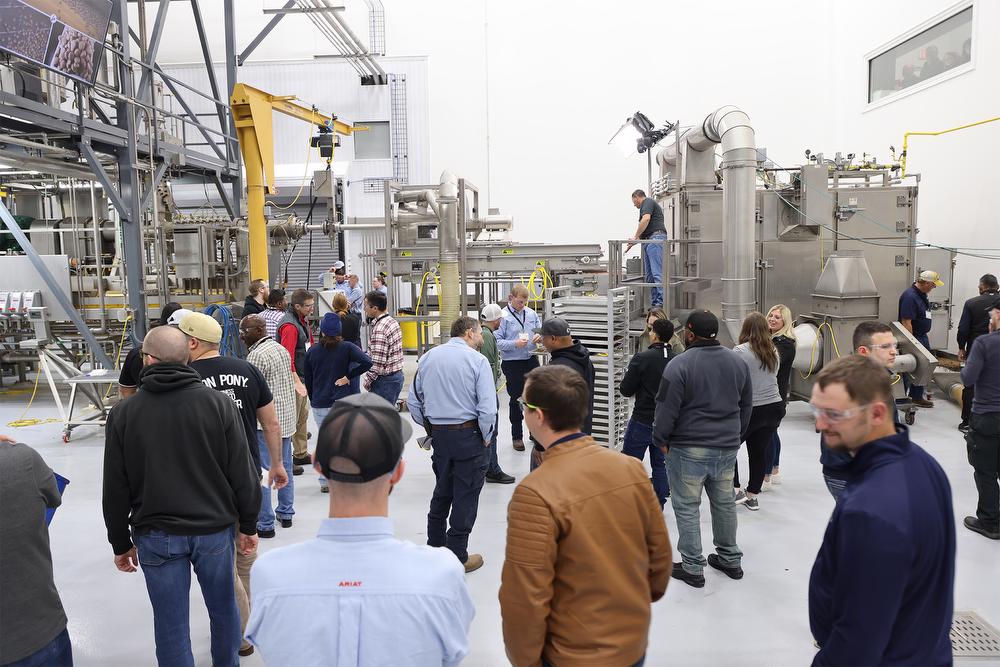
Lead managers from several Cargill production facilities participated in a structured training program focused on strengthening technical process knowledge and operational decision-making.
Classroom-Based Technical Instruction
Participants received detailed instruction on:
• Extrusion system components
• Process flow and equipment integration
• Operational best practices
• Key variables that impact product quality and density
Hands-On Equipment and Maintenance Training
Training groups rotated through practical stations focused on:
Equipment operation
• Preventative maintenance practices
• Identifying extrusion wear
• Troubleshooting common operational issues
Collaborative Process Discussions
Interactive discussions allowed Cargill leaders to review their existing processes, compare operational approaches between sites, and identify opportunities for improved process alignment moving forward.
Results & Measurable Benefits
The program delivered significant improvements in operational efficiency, product consistency, and cross-site alignment.
50% Increase in Productivity
Participants achieved a 50% improvement in productivity, measured as working hours per metric ton of product produced.
Reduced Product Giveaway
Cargill experienced a 2% reduction in shrink, representing a 25% decrease in product giveaway caused by finished product moisture falling below target levels.
Significant Reduction in Non-Quality Costs
Improved process control led to a $100,000 per month reduction in Cost of Non-Quality (CONC) associated with out-of-spec product requiring rework.
Stronger Technical Support Network
Participants established direct relationships with process experts, creating an ongoing resource for troubleshooting, operational support, and process optimization.
Unified Operational Vision
The training program helped align teams across multiple facilities, establishing a shared process strategy and operational standards across Cargill sites
Outcome:
Through targeted process training and cross-site collaboration, Cargill strengthened operational expertise, improved manufacturing efficiency, and significantly reduced costs related to product variability and rework.
More Articles
 Mar 18, 2026
•
5 Minute Read
Designing a Future-Ready Pet Food Manufacturing Facility
1SG partnered with the client to transform their concept into a structured, scalable manufacturing plan.
Read More
Mar 18, 2026
•
5 Minute Read
Designing a Future-Ready Pet Food Manufacturing Facility
1SG partnered with the client to transform their concept into a structured, scalable manufacturing plan.
Read More
 Mar 18, 2026
•
7 Minute Read
Transforming Customer Vision into Efficient Pet Food Production Solutions
Our approach focuses on collaboration, adaptability, and delivering measurable value throughout every stage of the project.
Read More
Mar 18, 2026
•
7 Minute Read
Transforming Customer Vision into Efficient Pet Food Production Solutions
Our approach focuses on collaboration, adaptability, and delivering measurable value throughout every stage of the project.
Read More
 Dec 19, 2023
•
8 Minute Read
Empathy: A Powerful Tool for Project Managers
Project managers working in a global marketplace are often the binding agents that help people from diverse backgrounds connect and find common ground. Customers, manufacturers, suppliers and other parties involved are all trying to achieve the same goal, and to be productive amid those challenges requires open-mindedness, patience and humility; and that can be summed up in one powerful word: Empathy.
Read More
Dec 19, 2023
•
8 Minute Read
Empathy: A Powerful Tool for Project Managers
Project managers working in a global marketplace are often the binding agents that help people from diverse backgrounds connect and find common ground. Customers, manufacturers, suppliers and other parties involved are all trying to achieve the same goal, and to be productive amid those challenges requires open-mindedness, patience and humility; and that can be summed up in one powerful word: Empathy.
Read More